The Sovereign Individual by James Dale Davidson Lord William Rees-Mogg
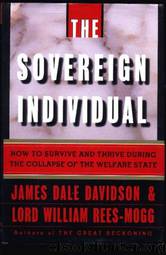
Author:James Dale Davidson, Lord William Rees-Mogg [James Dale Davidson, Lord William Rees-Mogg]
Language: eng
Format: epub
Published: 2016-06-30T22:47:24+00:00
ERADICATING INFLATION
Such possibilities notwithstanding, surely the most momentous consequence of the new digital money will be the end of inflation and the de-leverage of the financial system. The economic implications are profound. The rise of inflation in the twentieth century, as we argued in Blood in the Streets and The Great Reckoning, was intimately connected with the balance of power in the world. Increasing returns to violence dictated sharply higher military expenditures, which in turn required ever more aggressive efforts to expropriate wealth.
Governments found that they could effectively impose an annual wealth tax on all who held balances in their national currencies. This annual wealth tax on currency holders could also be seen as a transaction fee for allowing the users of currency to maintain their wealth in a convenient form provided by the issuers.* Thinking of inflation as a transaction fee for the convenience of holding currency may be unusual, but consider it closely. During the Industrial Age we became so accustomed to thinking of the provision of currency as a service for which one does not pay directly, that it was easy to forget that the issuers of the dollars, pesos, pounds, and francs, namely governments. did require that we pay, and pay dearly-through inflation.
The rate of this inflationary transaction fee on currency varied during the last half century from a low of 2.7 percent annually for the German mark, to rates perilously close to 100 percent. For example, between 1960 and 1991, when President Menem launched 164
Argentina's currency-board reform, inflation struck seventeen zeros off successive versions of Argentine currency. If all the wealth of the world had been converted into Argentine pesos in 1960 and buried, it would not have been worth the effort to spade it up by 1991.
Argentina's example is a leading indicator for the next millennium. Currency will not be inflated because other nationstates will no longer be able to get away with it, just as Argentina no longer can. Inflation had another lure during the industrial period when prices and wages were downwardly inflexible. Modest inflation increased output by reducing real wages and prices could be damaged by a credit contraction imported from other countries. Private money will not be inflatable because of competitive pressures.
The death of inflation will take away the disguised profits that inflation previously conveyed to those who were the monopolistic issuers of currency. If all the disguised profits of issuing money were extinguished, a new method of payment would be needed to compensate the issuers of currency directly. Use of the new monetary system will therefore probably involve a more explicit transaction cost, perhaps a fee on the order of 1 percent per annum. This will be a small price to pay compared to the annual inflationary penalty of from 2.7 percent to 99 percent imposed by nationstates. All the more so because there is a likelihood that overall prices will decline in the future as monopolies are eroded and competition intensifies worldwide.
Contracting Leverage
The emergence of digital money will
Download
This site does not store any files on its server. We only index and link to content provided by other sites. Please contact the content providers to delete copyright contents if any and email us, we'll remove relevant links or contents immediately.
International Integration of the Brazilian Economy by Elias C. Grivoyannis(111322)
The Radium Girls by Kate Moore(12096)
Turbulence by E. J. Noyes(8121)
Nudge - Improving Decisions about Health, Wealth, and Happiness by Thaler Sunstein(7761)
The Black Swan by Nassim Nicholas Taleb(7200)
Rich Dad Poor Dad by Robert T. Kiyosaki(6728)
Pioneering Portfolio Management by David F. Swensen(6342)
Man-made Catastrophes and Risk Information Concealment by Dmitry Chernov & Didier Sornette(6142)
Zero to One by Peter Thiel(5874)
Secrecy World by Jake Bernstein(4804)
Millionaire: The Philanderer, Gambler, and Duelist Who Invented Modern Finance by Janet Gleeson(4539)
The Age of Surveillance Capitalism by Shoshana Zuboff(4355)
Skin in the Game by Nassim Nicholas Taleb(4310)
The Money Culture by Michael Lewis(4268)
Bullshit Jobs by David Graeber(4252)
Skin in the Game: Hidden Asymmetries in Daily Life by Nassim Nicholas Taleb(4052)
The Dhandho Investor by Mohnish Pabrai(3826)
The Wisdom of Finance by Mihir Desai(3793)
Blockchain Basics by Daniel Drescher(3641)
